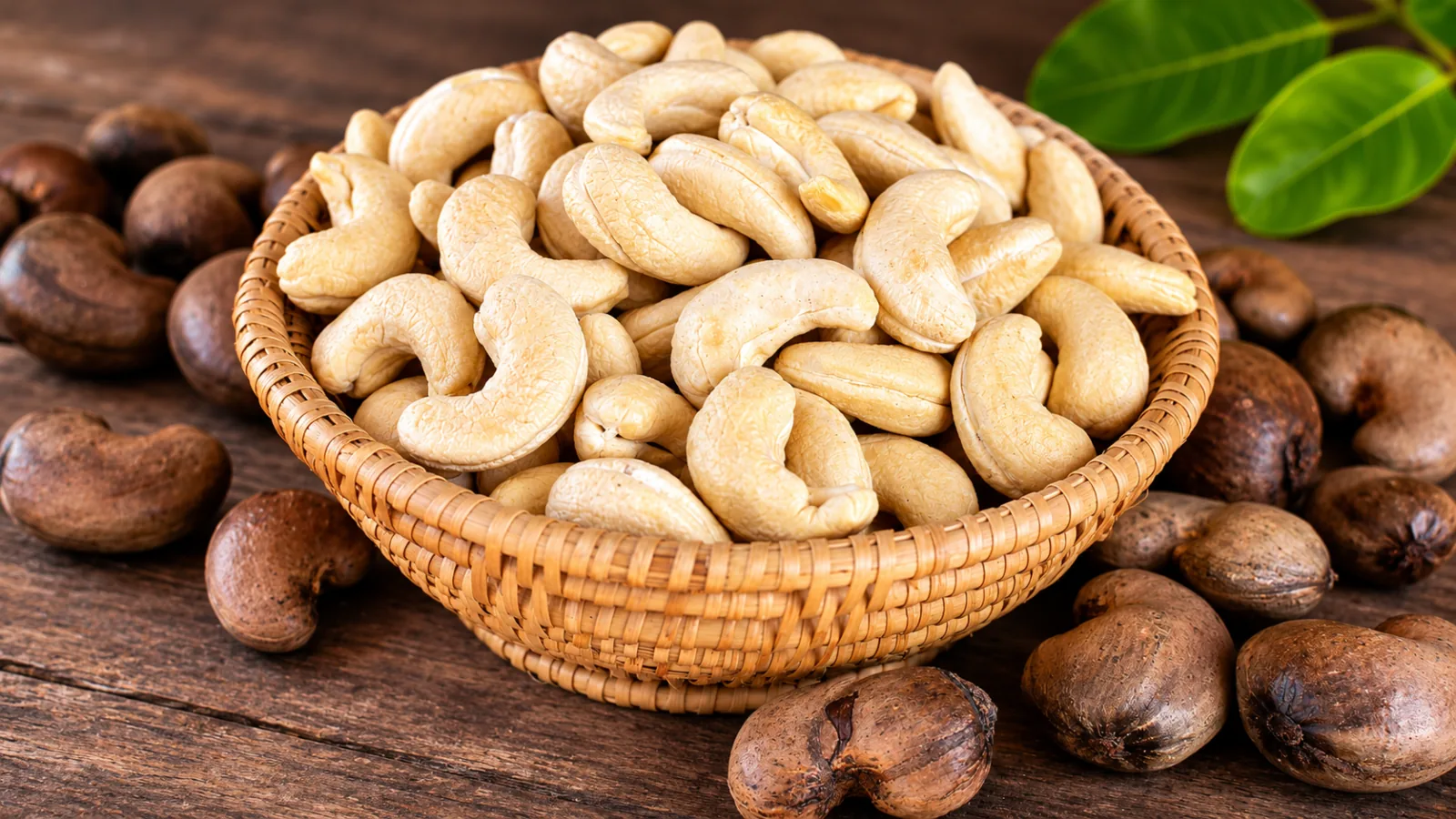
The crescent kernel in kaju katli began as a seed beneath a bright cashew apple. Follow its journey from tropical America to Goa and Indian kitchens.
Think of the last cashew you ate: perhaps tucked into kaju katli, stirred into a silky curry, or pulled from a snack bowl. The pale crescent seems simple enough. Yet on the tree, it hangs beneath a bright, pear-shaped cashew apple. The snack in your hand is only one part of a much stranger fruit.
So, are cashews really nuts? Botanically, the edible kernel is a seed. And how did a South American tree become so familiar in Indian kitchens? The answer travels from a flower stalk to Goa, then on to sweets, gravies and festive snack tins.
Wait, are cashews actually nuts?
In everyday cooking, “nut” is a useful food word: cashews, almonds and walnuts sit together in recipes and snack mixes. Botany uses the word more narrowly. A true nut is a dry fruit with a hard shell that does not split open when ripe. The cashew we eat does not fit that definition.
The familiar curved kernel is the seed. It sits inside a kidney-shaped, shell-covered fruit, while the red or yellow “apple” beside it is a swollen flower stalk. In other words, the thing most people call the cashew nut is a seed packaged inside a fruit, attached to a second fleshy structure. Kew’s botanical description notes the fruit on a thickened, fleshy stalk and the separate kidney-shaped seed.
This botanical distinction does not make cashews safe for someone with a cashew or tree-nut allergy. Cashews are treated as tree nuts in food allergy and labeling guidance. Anyone with an allergy should follow their clinician’s advice and avoid experimenting based on plant terminology.
Where do cashews come from?
The cashew tree, Anacardium occidentale, is native to tropical America. Kew records its native range from Trinidad to southern tropical America; Brazil is central to the crop’s origin story, but it is not the whole range. Long before cashews became a familiar Indian ingredient, communities in the Americas knew the tree and its edible apple and seed.
The Portuguese carried the tree across tropical trade routes. In the history commonly documented by India’s Agricultural and Processed Food Products Export Development Authority (APEDA), Portuguese traders introduced cashew to India in the 16th century, first in Goa. From that coastal foothold, it spread to other parts of the peninsula.
How did cashews reach India?
The early Indian story was agricultural before it was culinary. Cashew trees can tolerate dry conditions and poorer soils. APEDA and Indian horticultural accounts describe their planting on degraded land and slopes to help check soil erosion. They were useful trees in a landscape where a hardy crop could establish itself along the coast.
Over time, growers and processors found value in the kernel as well as the tree. Processing turned cashew from a useful planting into a crop with commercial value, and cultivation extended along India’s western and eastern coasts. Goa remained especially associated with cashew apples and their local uses. The history is a gradual change in how people used the crop, not a single documented moment when a particular sweet or curry was invented.
Why does one cashew hang below each cashew apple?
A cashew tree produces clusters of small flowers. From an individual flower, the ovary develops into the kidney-shaped true fruit; that fruit holds one seed. The short stalk behind it then swells into the much larger, fleshy cashew apple. Botanists call this an accessory fruit, or a false fruit, because much of its edible flesh grows from the stalk rather than the ovary.
That is why the cashew looks as though it dangles from the bottom of a little pear. It is not a nut growing inside the apple. The apple and the shell-covered fruit are two connected parts of one unusual arrangement.
Why are cashews expensive?
A packet of kernels hides a careful sequence of work. Ripe apples and their attached fruits are collected, then separated. The fruits are dried before processing. The hard shell must be treated and removed without damaging the pale kernel; its inner layers contain cashew nut shell liquid, an irritating, caustic substance. Depending on the process, shells are conditioned by heat or steam before workers or machines open them.
After shelling, the thin skin around each kernel is peeled away. The kernels are then sorted by size, condition and whether they remain whole, before packing. These stages take skill and time, and delicate kernels can break during handling. That combination of careful processing, grading and handling helps explain the price; there is no single processing step that accounts for all of it.
Cashews sold for eating have already been processed to make the kernel safe to handle and consume. “Raw cashews” on a food label does not mean an untouched nut still inside its original shell. Do not crack or roast fresh, unshelled cashews at home: the shell liquid can injure skin and its fumes can irritate.
What happens to the cashew apple?
The apple is edible when ripe. Its flavour can be sweet and fruity, with a mouth-drying astringency that varies by variety and ripeness. It is soft and bruises easily, so it does not travel or keep like the processed kernel. In places where cashews grow, people use the juice and flesh in drinks, jams, jellies, syrups and other local products.
In Goa, fermented cashew-apple juice is distilled into cashew feni, a drink with a protected regional identity. Goa also makes coconut feni from coconut nectar; it is a different product, not a cashew-apple version. Outside growing regions, the apple is much less visible in markets than the kernel, even though one tree produces both.
How kaju became part of Indian cooking
Once cashew was established in India, the kernel suited both celebratory sweets and everyday cooking. Kaju katli turns finely ground cashews into a smooth, diamond-cut sweet. Whole or chopped cashews bring richness and crunch to festive mithai, pulao and snack mixes. In curries, a ground cashew paste can thicken a gravy and lend it a rounded, creamy texture.
Kaju curry, kaju masala and cashew-based gravies are now familiar menu names, but it is better not to invent a precise origin story for any one of them. They show how cooks made a useful crop their own. If you enjoy rich gravies, try FullMeals’ home-style butter chicken or dhaba-style paneer butter masala. For more festive planning, see our guide to Diwali sweets and snacks.
Five cashew facts worth sharing
- The botanical name is Anacardium occidentale; cashew belongs to the same plant family as mango and pistachio.
- The cashew apple can be red or yellow, and cultivars differ in juice, size and astringency.
- Cashew apples are so soft and perishable that they are often enjoyed near where they are grown rather than shipped far away.
- Cashew nut shell liquid is a useful industrial material as well as a processing hazard; it is used in products such as resins and friction materials.
- “Feni” can mean a spirit made from cashew apples or from coconut nectar. In Goa, the source determines whether it is cashew feni or coconut feni.
The next time you eat a cashew…
You will know that the crescent in your hand began as a seed beneath a cashew apple, on a tree that crossed oceans before finding a home in Goa. From there, careful processing and generations of cooking turned kaju into a familiar part of Indian food. One small kernel carries a surprisingly long journey.
Frequently asked questions
Are cashews nuts or seeds?
The edible cashew kernel is a seed inside a shell-covered fruit. “Nut” is the familiar culinary name, and cashews are still treated as tree nuts for allergy precautions.
Which country did cashews originally come from?
Cashew is native to tropical America, including Brazil. Its natural range extends beyond Brazil into other parts of tropical South America and the Caribbean.
Who introduced cashews to India?
Historical accounts commonly credit the Portuguese with bringing cashew trees to Goa in the 16th century.
Why are cashews expensive?
Each kernel must be separated, dried, safely shelled, peeled, graded and packed. Careful handling also helps preserve whole kernels instead of broken pieces.
Can you eat the cashew apple?
Yes. Ripe cashew apples are edible and used in drinks, preserves and regional products, including cashew-apple feni in Goa.
Why shouldn’t you eat cashews directly from the shell?
The shell contains caustic liquid that can irritate or injure skin. Food-grade kernels have been processed to remove the shell safely; do not crack or roast fresh, unshelled cashews at home.