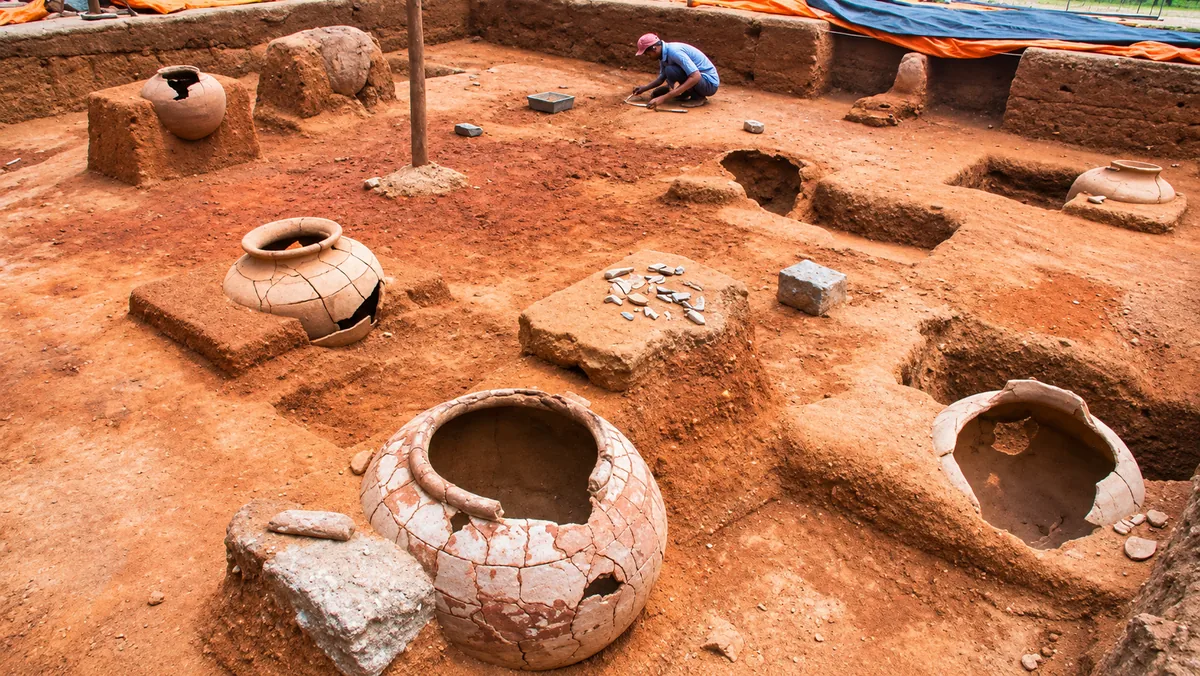
Chemical traces in pottery from Keeladi in Tamil Nadu and Gottiprolu in Andhra Pradesh offer evidence consistent with cow’s milk use and plant processing between 600 and 100 BCE. We explain what this new study can tell us about ancient South Indian food—and where four sherds leave the story open.
A broken clay pot can look silent. Yet more than 2,000 years after it was used, tiny chemical traces may still hint at what touched its surface. In a study published in October 2026, researchers analysed four unglazed pottery fragments from Keeladi in Tamil Nadu and Gottiprolu in Andhra Pradesh. They found lipid patterns consistent with cow’s milk and a complex plant-derived molecule linked to plant processing. The clues are exciting, but they are not a complete menu of ancient Tamil food.
What did ancient Tamils actually eat?
The careful answer is that this particular study found chemical evidence consistent with dairy use and plant processing in a small set of vessels. It cannot tell us everything people ate, or what every household served. Archaeologists build a broader picture by combining pottery residues with animal bones, preserved seeds and grains, agricultural evidence, and texts interpreted in their historical context.
Each kind of evidence answers a different question. A seed may show that a plant was present; a cut-marked bone can help identify how an animal was used; a residue can show that certain molecules came into contact with a vessel. None alone recreates an entire meal. This article focuses on the findings from the four sherds, rather than turning them into an imagined daily menu.
The discovery hidden in 2,000-year-old pottery
The peer-reviewed study, published in npj Heritage Science, examined unglazed pottery dated broadly to 600–100 BCE. Two fragments came from Keeladi, whose pottery in the study is dated to the sixth through second centuries BCE; two came from Gottiprolu, dated to the second through first centuries BCE. A report on the study also describes the four-fragment sample, a useful reminder of how focused this evidence is.
The researchers reported distinct lipid profiles consistent with cow’s milk. They also identified a linear A-type procyanidin tetramer, a complex plant-derived compound not previously reported from an archaeological context. Together, these findings offer evidence about dairy use and plant processing at the sampled places and times. They do not prove that a particular named dish was cooked in either pot.
How can a clay pot preserve food clues for millennia?
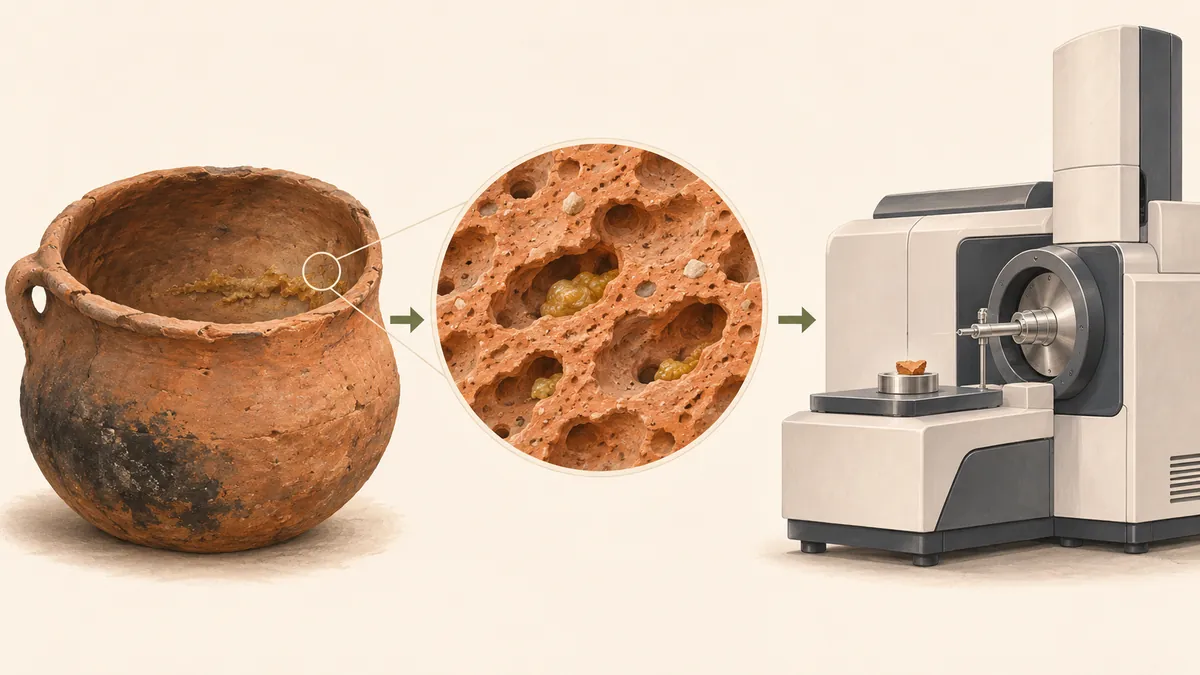
Unglazed pottery has a rough, porous structure. When food is cooked or stored in it, some fats and other organic molecules can move into tiny pores. The visible food breaks down, but a fraction of these molecules can remain protected in the ceramic. Researchers can later sample the vessel and look for chemical signatures left behind.
This approach is called organic residue analysis, or ORA: scientists study surviving molecules to learn what kinds of substances may have contacted an object. In this study, X-ray micro-computed tomography helped examine pottery structure without cutting it open, while UPLC-Q-ToF-MS/MS separated a complex chemical mixture and measured molecular signals. In plain language, one technique looked inside the ceramic; another helped identify patterns in the residue.
A chemical signature is a clue, not a ready-made recipe. Laboratory analysis cannot automatically say whether an ingredient was boiled, fermented, mixed with another food, or eaten as part of a particular meal.
Does the evidence show that people used milk?
The study’s lipid profiles were consistent with cow’s milk, and the authors discuss them alongside animal evidence from the region. That makes dairy use a supported interpretation for the vessels analysed. It still does not tell us whether the residue came from milk used on its own, from a processed dairy product, or from a mixture that included other ingredients.
It would be a leap to name modern foods such as curd rice, paneer, payasam or a specific ghee sweet from these results. The study did not identify those dishes. Its value is more basic and more durable: it adds direct molecular evidence to questions about cattle, food processing and daily life in early South India.
What is the mysterious plant compound?
Procyanidins are plant-derived polyphenols, a broad group of compounds found in different plants. A tetramer is built from four linked units; “A-type” describes part of the way those units are connected. The structure detected in the pottery resembles compounds reported in peanut skins, which makes peanuts one possible comparison—not a secure identification of the ancient plant.
That distinction matters because a molecular match is not the same as finding a peanut seed. Similar compounds can occur across plant materials, and a chemical trace may not preserve enough information to identify a species. The Indian Council of Agricultural Research’s crop-history summary places groundnut’s introduction to India with Portuguese travellers from about 1510 onward. The new result raises a question against that conventional chronology; it does not settle it or rewrite it. Food ingredients have travelled in surprising ways before, as our story on how cashew reached India also shows.
Why does Keeladi matter to Tamil history?
Keeladi is in Sivaganga district, near the Vaigai River and southeast of Madurai. The Tamil Nadu Department of Archaeology documents settlement remains and finds including pottery, structural features, tools and other everyday objects. These materials help researchers investigate how people lived, worked and made things in the region. The residue study adds a new kind of evidence to that larger archaeological record; it does not, by itself, describe all of Keeladi’s society or diet.
Did ancient kitchens look anything like ours?
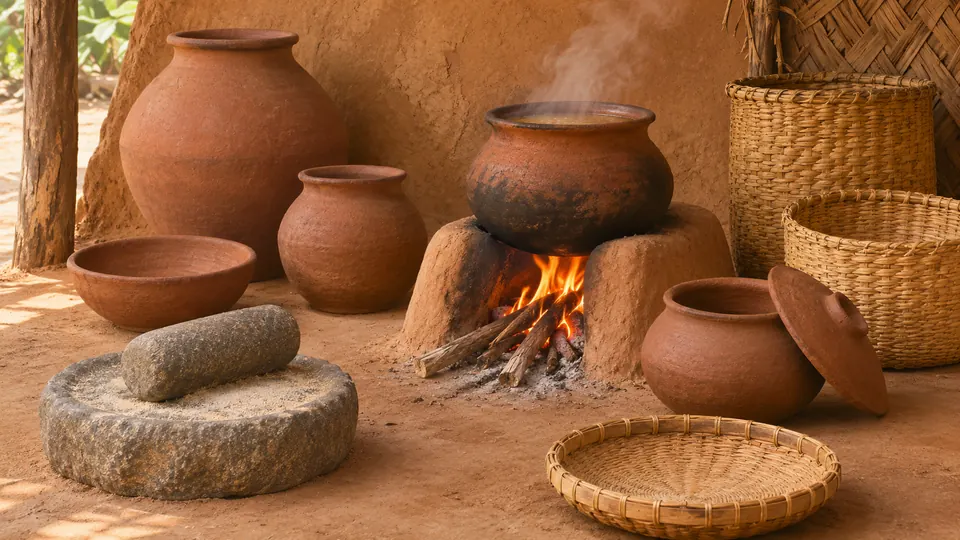
We can picture some shared needs—cooking, storing and processing food—but should be cautious about claiming the rest. A pot in an excavation is evidence of a vessel, not a full reconstruction of a kitchen. The study does not identify grains, spices, cooking fires or a recipe. Modern clay-pot cooking can help us appreciate the material, but it should not be treated as a direct copy of an ancient method.
Five small facts about food archaeology
- Pottery can retain chemical traces even when the original food has disappeared.
- Researchers can study food history without finding an intact meal.
- Residues, animal bones and plant remains can complement one another.
- Modern instruments can detect complex molecules that older methods may miss.
- A small sample can open valuable questions while leaving many answers unresolved.
What do we still not know about ancient Tamil food?
Four sherds cannot establish what every family ate, how often milk was used, which plant species left the procyanidin, or the exact techniques behind a meal. Nor does this study prove that people in Keeladi and Gottiprolu shared identical food practices. The findings describe chemical traces in a limited set of vessels, not the full diet of a population across centuries.
More pottery, secure plant remains, animal evidence and future chemical analyses can refine the picture. Good archaeology makes room for both discovery and uncertainty: a strong clue is worth following, even when it cannot answer every question yet.
The next time you cook in a clay pot…
Think of the vessel as more than a container. In the right conditions, it can carry a faint record of what once touched it. The pots in our kitchens are not the same objects or histories as those found at Keeladi, but the material link is a reminder that ordinary tools can outlast the meals they helped make. Sometimes, a broken pot still has a story left to tell.
For another evidence-led look at everyday food habits, read our guide to when dal needs soaking, or explore more food stories and recipes on FullMeals.
Frequently asked questions
What did ancient Tamil people eat?
The full diet varied by place and period, and no single study can list it. This study found traces in four vessels consistent with cow’s milk use and plant processing. Archaeologists combine such residue evidence with animal bones, seeds, grains and other records to build a broader picture.
What did scientists discover in Keeladi pottery?
Researchers reported lipid profiles consistent with cow’s milk and a plant-derived linear A-type procyanidin tetramer in the sampled pottery. The molecule may point to plant processing, but it does not identify a specific dish or prove which plant species left the trace.
Did ancient South Indians drink cow’s milk?
The residue study found chemical profiles consistent with cow’s milk in pottery from Keeladi and Gottiprolu. That supports dairy use in the sampled context. It cannot tell whether people drank milk directly or used it in a particular preparation.
How do scientists know what people ate thousands of years ago?
They study clues such as food residues absorbed into pottery, preserved plant remains and animal bones. Chemical methods can identify molecular patterns in residues, while other evidence helps test and contextualise those interpretations. Each clue has limits and works best alongside the others.
Did ancient Tamil people eat the same food we eat today?
Some ingredients or cooking needs may have long histories, but this study does not connect its residues to modern recipes. Food names and dishes cannot be projected backward without separate evidence. The findings reveal broad clues about dairy and plant processing, not continuity of a particular meal.