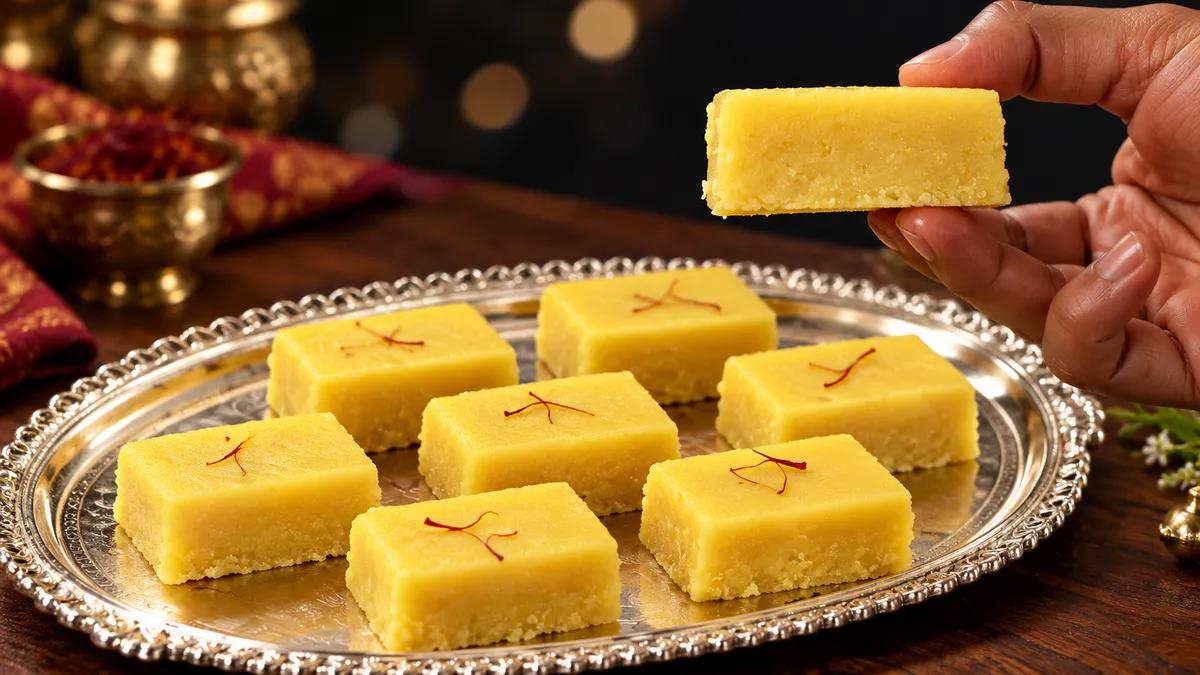
Mysore Pak turning hard, crumbly or greasy? Understand the techniques behind a softer texture and seven common mistakes to avoid.
Soft Mysore Pak looks simple, but a small change in the flour, syrup, ghee or finishing stage can leave it firm, greasy or crumbly. Follow one method from start to finish: soft and porous styles use related ingredients, but their methods and proportions are not interchangeable.
This guide covers seven common mistakes and the cues to watch for. FullMeals’ Ghee Mysore Pak is a specific set-to-cut version; its page does not promise a fudge-like texture. Follow its measurements as written rather than changing proportions to get a different style.
What makes Mysore Pak soft and melt-in-the-mouth?
Texture depends on the balance of besan, sugar and ghee, flour preparation, syrup and when cooking stops. Soft-style recipes are usually finished differently from versions meant to set firmly or develop a porous crumb. Follow the chosen recipe: no single syrup stage or ghee ratio applies to every Mysore Pak.
Know the ingredients and the method
Besan provides the body; sifting removes lumps, while roasting is method-dependent. Sugar contributes sweetness and structure. Ghee brings richness, so its quantity and incorporation affect texture. In the FullMeals recipe, water dissolves the sugar before the besan mixture is added.
In that recipe, the listed ingredients are 1 cup (250 ml) gram flour, 150 ml ghee, 1 cup (250 ml) sugar, and ¼ cup water, with saffron for garnish. It roasts and sieves the flour, mixes half the melted ghee into it, dissolves the sugar in water, combines the mixtures, then adds the remaining ghee gradually. The stated yield is 8 servings; prep and cooking total 30 minutes, followed by 2 hours of setting.
Follow one coherent cooking sequence
- Get ready first. Measure the ingredients and grease the setting tray before you heat anything. Mysore Pak can thicken quickly near the end, so keep the tray and spatula within reach.
- Prepare the besan as the recipe says. For the FullMeals method, roast it over moderate heat until aromatic and the raw smell has gone, then sieve it. Mix in half the melted ghee until smooth and lump-free.
- Dissolve the sugar. Stir the sugar into the measured water over low to medium heat until dissolved. This particular recipe does not specify a one-string stage; don’t keep boiling it to a stage borrowed from another method.
- Combine carefully. Add the besan-ghee mixture to the dissolved sugar and stir over low heat until combined. Keep the mixture moving so it heats evenly.
- Add the rest of the ghee gradually. Stir in small portions, letting each addition incorporate before adding more. The recipe describes the finish as a thick mixture that forms a mass and slides off the spatula.
- Transfer and let it set. Move the mixture promptly to the greased tray, spread it evenly, and leave it undisturbed for the recipe’s two-hour setting period. Let it cool before turning it out and cutting.
Seven Mysore Pak mistakes to avoid
1. Mixing measurements from different recipes
What goes wrong: the mixture may turn out too firm, oily or unable to set as expected. Why: recipes balance besan, sugar and ghee differently for distinct textures. Do this: choose one reliable method and measure its ingredients as written. Don’t borrow a ghee quantity or syrup stage from another version halfway through.
2. Leaving lumps in the besan
What goes wrong: dry pockets can remain in the cooked sweet. Why: lumps are harder to disperse once the flour meets hot syrup. Do this: sieve the flour when the method calls for it, and rub the recipe’s ghee into it until the mixture is smooth before combining.
3. Using the wrong sugar-syrup cue
What goes wrong: over-concentrated syrup can push the sweet toward a harder set, while an underdeveloped syrup may not give the intended structure. Why: the syrup stage controls how the sugar behaves as the mixture cooks. Do this:follow the selected recipe’s stated stage. The FullMeals method asks for the sugar to dissolve before adding besan; it does not instruct you to cook to one-string consistency. Never test boiling syrup by touching it with bare fingers.
4. Adding ghee all at once
What goes wrong: ghee may separate or the mixture may become greasy. Why: the fat has not had time to incorporate into the flour-and-sugar mixture. Do this:for the FullMeals method, add the second half in small portions while stirring, and let each portion absorb before adding the next. Other methods may use a different sequence.
5. Cooking over heat that is too high
What goes wrong: the base can scorch while the rest thickens too quickly to manage. Why: intense heat narrows the window between a fluid mixture and an overcooked one.Do this: use a heavy pan if available, keep the heat controlled, and stir continuously as the mixture thickens. Adjust for your burner rather than relying on a fixed flame label.
6. Cooking past the recipe’s finishing cue
What goes wrong: Mysore Pak can become dry or hard.Why: continued cooking drives the mixture beyond the texture it is meant to set at. Do this: watch the consistency, not just the clock. The FullMeals recipe’s cue is a thick mass that slides off the spatula; transfer it as soon as it reaches that point instead of waiting for it to look dry.
7. Waiting too long to transfer or cutting too soon
What goes wrong: the mixture can set unevenly in the pan, or pieces may crack when cut. Why: the tray was not ready, the layer is uneven, or the sweet has not rested enough.Do this: grease the tray before cooking, transfer promptly, spread to an even depth, and allow the full setting time. Use a knife only after the slab has cooled and released from the tray.
Mysore Pak troubleshooting at a glance
| Result | Possible cause | What to review |
|---|---|---|
| Too hard | Overcooking or syrup taken further than the method requires | Recipe-specific finishing cue and heat |
| Greasy | Ghee balance or incorporation issue | Measurements and gradual addition steps |
| Lumpy | Besan not sieved or mixed smoothly | Flour preparation before it meets syrup |
| Cracks while cutting | Uneven thickness or cutting before it sets | Tray preparation, cooling and setting time |
| Does not hold its shape | Mixture has not reached the method’s finish or set | Cooking cue and full setting period |
Can you fix hard or crumbly Mysore Pak?
Broken edges can be served in smaller portions. But a batch made very hard by overcooking generally cannot be softened again by adding water or reheating. Crumble dry pieces over ice cream if you like; this makes them easier to serve, but does not reverse the cooking. For the next batch, adjust the finish rather than several ingredient amounts.
Setting, cutting and storing
Prepare a clean tray and grease it before starting. Spread the hot mixture quickly and evenly, taking care not to touch it directly. Let it cool and set for the time stated in the recipe; for the FullMeals version, that is two hours at room temperature. Loosen the sides with a knife, invert the tray onto a board, and cut with a firm downward motion. If it crumbles, pause and let it set longer before trying smaller pieces.
Once fully cool, store pieces in a clean, dry, airtight container away from heat and moisture. The FullMeals recipe does not specify a tested shelf life, so avoid assigning it a fixed number of days. Discard pieces if they become damp, contaminated, or show signs of spoilage.
Frequently asked questions
Why does Mysore Pak become hard?
Common causes include cooking past the recipe’s finish cue or taking the sugar syrup further than that method requires. Follow one recipe’s proportions and stop when its mixture cue appears.
Does every Mysore Pak recipe need one-string syrup?
No. Syrup stages depend on the method. The FullMeals recipe linked below dissolves sugar in water and does not specify one-string consistency.
Why is my Mysore Pak greasy?
Check whether the ghee amount matches your recipe and whether it was added in the sequence the method specifies. For FullMeals’ version, the second half is added gradually while stirring.
When should I cut Mysore Pak?
Let it cool and set for the full time specified by your recipe. FullMeals’ Ghee Mysore Pak recipe calls for two hours before turning it out and cutting.
Can I make Mysore Pak ahead for Diwali?
It can be prepared ahead if you allow its full setting time and store it as directed. For a wider festival cooking schedule, see the FullMeals guide to planning Diwali sweets and snacks.
Ready to make Mysore Pak at home?
Try the published FullMeals Ghee Mysore Pak recipe for its specific measurements, gradual ghee method and two-hour setting instructions. It is listed as a set-to-cut version rather than a guaranteed soft style, so use its own method and texture cues as written.
For a softer result, treat the recipe you choose as a complete system: keep its ingredient balance, syrup instructions and finish cues together. That consistency gives you a better chance of understanding what changed if the next batch turns out firmer or softer than you wanted.
Planning a full festive menu? FullMeals’ separate Diwali sweets and snacks guide covers what to prepare ahead and what to finish fresh.